Graduating with a cybersecurity degree can feel both exciting and overwhelming. The industry is growing quickly, but the number of job titles, specialisms, and pathways can make it difficult to know where to start.
The good news is that cybersecurity is not a single career path. It is a broad field made up of many different roles, each focusing on a different part of how we protect systems, data, and people.
Understanding these paths early can help graduates make more informed decisions about where to begin and how to grow.
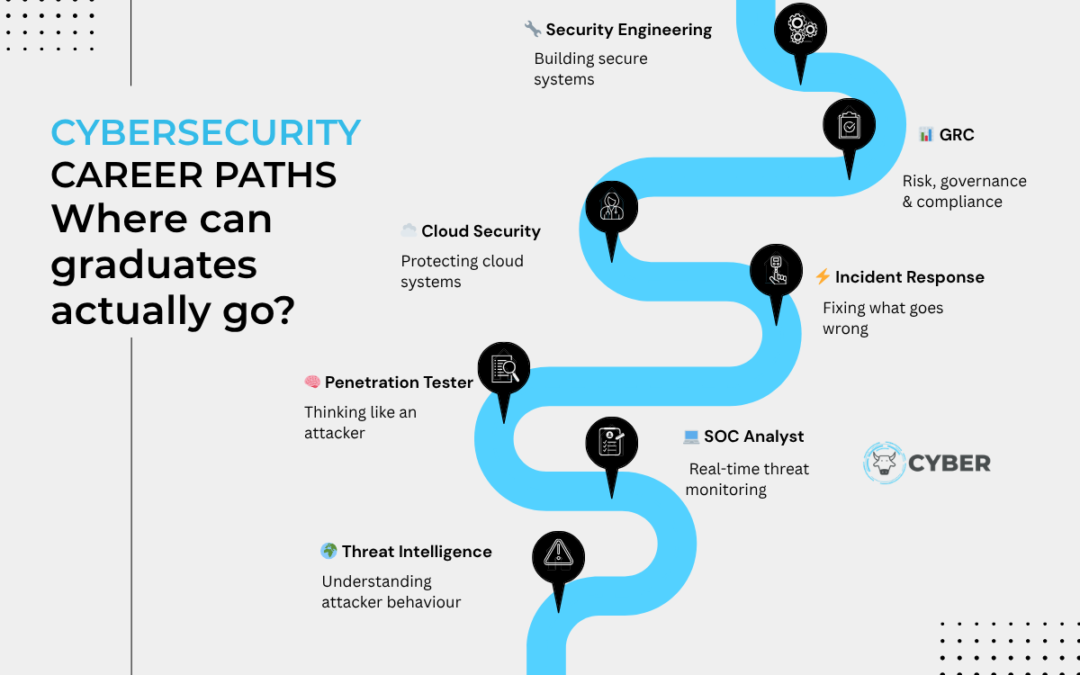
Security Analyst (SOC Analyst)
One of the most common entry points into cybersecurity is working in a Security Operations Centre, often known as a SOC.
Security analysts monitor systems for suspicious activity, investigate alerts, and respond to potential incidents. It is a fast-paced environment where you learn how attacks are detected in real time.
This role is often recommended for graduates because it builds a strong foundation in understanding how threats actually appear in real environments.
Penetration Tester (Ethical Hacker)
Penetration testing focuses on thinking like an attacker in order to find vulnerabilities before criminals do.
In this role, you are legally simulating attacks on systems, applications, or networks to identify weaknesses.
It requires creativity, curiosity, and a strong understanding of how systems work. Many people are drawn to this path because it is more hands-on and investigative.
Incident Response Specialist
Incident response is about what happens when something goes wrong.
These professionals investigate cyber attacks, contain damage, and help organisations recover from security incidents.
It is a high-pressure role, often requiring quick decision-making and strong analytical thinking. No two incidents are ever the same, which makes the work dynamic and challenging.
Governance, Risk and Compliance (GRC)
Not all cybersecurity roles are technical. GRC focuses on policies, risk management, and ensuring organisations meet legal and regulatory requirements.
This path is ideal for graduates who are interested in structure, communication, and strategic thinking rather than hands-on technical work.
It plays a critical role in ensuring that security is embedded into business operations.
Cloud Security
As more organisations move to cloud platforms, securing cloud environments has become a major specialism.
Cloud security professionals work on protecting data, configuring secure cloud infrastructure, and ensuring that cloud services are properly managed.
This area is growing quickly and often overlaps with DevOps and software engineering roles.
Threat Intelligence
Threat intelligence focuses on understanding who is attacking, how they operate, and what their motivations are.
Rather than reacting to incidents, this role focuses on anticipating them by analysing patterns, data, and global cyber trends.
It requires strong research and analytical skills, and often involves working with large sets of information.
Security Engineering
Security engineers design and build systems that are secure by default.
This can include developing security tools, implementing protective systems, and ensuring infrastructure is resilient against attacks.
It is one of the more technical career paths and often requires strong programming and systems knowledge.
Choosing the right path
There is no single “correct” entry point into cybersecurity. Many professionals move between roles as they gain experience and discover what suits them best.
A SOC role might lead to incident response. Penetration testing might lead to red teaming. GRC experience might lead to leadership or risk management roles.
What matters most early on is building strong fundamentals and gaining exposure to how different parts of cybersecurity connect.
Final thought
Cybersecurity is not one career. It is a collection of paths that all lead toward the same goal: protecting systems, data, and people.
For graduates, the key is not choosing the perfect path immediately, but choosing a starting point that allows learning, growth, and curiosity.