For many years, cybersecurity was seen as an IT problem.
Something for the technical team to handle.
Something discussed in server rooms rather than boardrooms.
That mindset no longer works.
Today, cyber incidents can disrupt operations, impact revenue, damage reputations, trigger regulatory investigations, and erode customer trust. The consequences reach far beyond technology.
That’s why cybersecurity has become a business issue, not just an IT issue.
The challenge is that many business leaders don’t come from technical backgrounds. They don’t need to understand every security control, but they do need to ask the right questions.
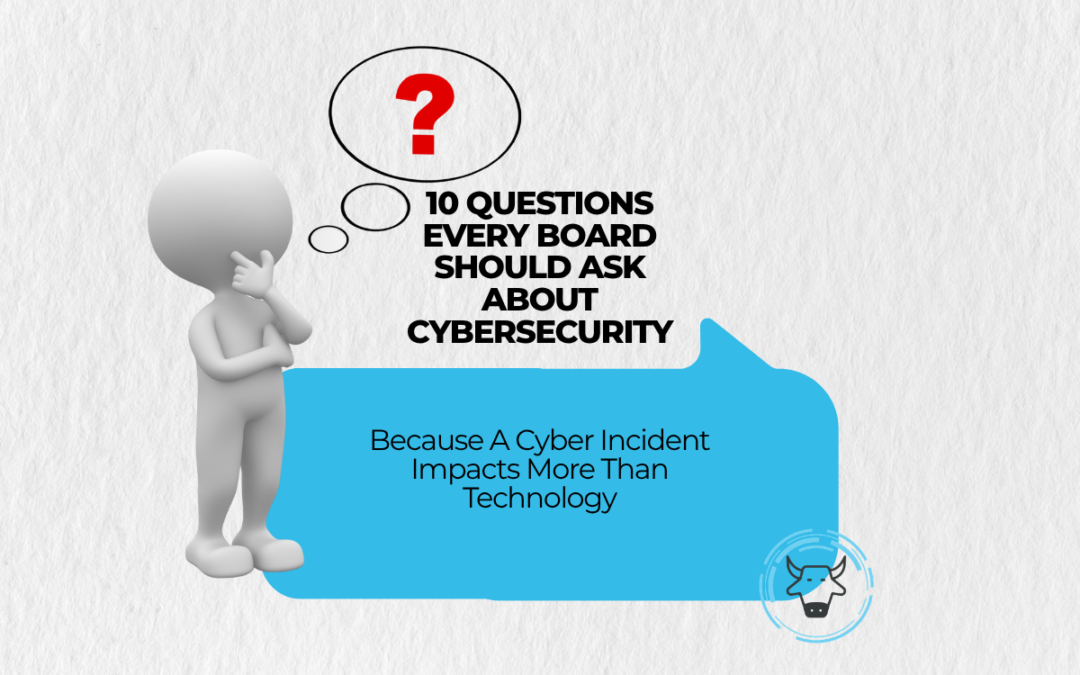
Here are ten questions every board should be asking.
1. What Are Our Biggest Cyber Risks?
Every organisation faces different threats.
Understanding the most significant risks is the foundation of effective decision-making.
If leadership can’t clearly identify the top cyber risks facing the business, that’s a concern.
2. What Would Happen If We Were Breached Tomorrow?
This question often reveals gaps very quickly.
How would operations be affected?
How long would recovery take?
Who would be responsible for managing the response?
Understanding the business impact is just as important as understanding the technical impact.
3. Do We Have an Incident Response Plan?
Many organisations have security tools.
Far fewer have a tested response plan.
A cyber incident is not the time to decide who should be making decisions.
4. Have We Tested Our Backups?
Having backups and being able to restore from backups are very different things.
Boards should know whether recovery processes are regularly tested and how quickly critical systems can be restored.
5. Are Our People Prepared?
Technology alone won’t solve cybersecurity challenges.
Employees remain one of the most targeted attack vectors.
Awareness training, reporting processes, and security culture all play an important role in reducing risk.
6. How Are We Managing Third-Party Risk?
Your security is often only as strong as the weakest supplier with access to your systems or data.
Boards should understand how critical suppliers are assessed and monitored.
7. Are We Using AI Securely?
As AI adoption increases, new risks emerge.
How is sensitive data being handled?
Are employees using approved AI tools?
Are governance controls in place?
These questions are becoming increasingly important.
8. How Do We Measure Cybersecurity Performance?
If cybersecurity is a business risk, it needs meaningful reporting.
Boards should receive metrics that demonstrate risk, resilience, and progress rather than simply technical activity.
9. Do We Meet Our Regulatory Obligations?
Data protection, reporting requirements, and industry regulations continue to evolve.
Leadership should have confidence that the organisation understands and meets its obligations.
10. Are We Investing in the Right Areas?
Cybersecurity budgets are not unlimited.
The goal isn’t to buy every available tool.
The goal is to invest in the controls, processes, and people that reduce the most significant risks.
The Most Important Question
Of all the questions above, perhaps the most important is this:
Are we treating cybersecurity as a business priority or simply an IT responsibility?
The organisations that build resilience understand that cybersecurity is not owned by one department.
It requires engagement from leadership, collaboration across the business, and ongoing attention from the board.
Because when a cyber incident occurs, the impact is rarely limited to technology.
And neither is the responsibility.