Think you can spot a phishing email?
Poor spelling. Strange grammar. A suspicious address. An urgent request from someone you’ve never heard of.
Those obvious scams are becoming easier to recognise.
The problem? The next generation may look completely legitimate.
During Cyber Security Awareness Month, it’s worth asking:
Would you recognise a scam if it looked, sounded and felt real?
AI is changing phishing
Generative AI can help attackers create convincing messages in seconds. Emails can be professionally written and tailored to specific people.
And it’s not just email.
Attackers can use voice cloning, deepfakes, SMS scams, QR-code phishing and impersonation to make fraudulent requests appear to come from someone you trust.
Imagine receiving a voice message from your CEO asking you to urgently transfer money.
It sounds like them.
The request sounds plausible.
Would you stop and verify it?
You don’t need to recognise every new type of scam. You need to develop the habit of pausing before acting.
Before clicking, paying, downloading or sharing information, ask:
Was I expecting this?
Does the request make sense?
Is there unusual urgency?
Can I verify it another way?
If your “CEO” emails asking for a payment, don’t reply to the email to check. Call them using a trusted number you already have.
Make reporting easy
Mistakes happen. What matters is what happens next.
During Cyber Security Awareness Month, make sure everyone knows exactly where to report suspicious messages or potential incidents.
Whether it’s a phishing button, security email or internal reporting form, keep it simple.
And make the message clear:
If you’re unsure, report it. If you’ve clicked, report it. If something feels wrong, report it.
The faster your organisation knows, the faster it can respond.
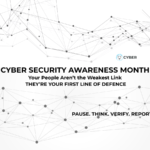
Stop. Think. Verify. Report.